
Living on the Interest: Why I Never Touch My “Million”
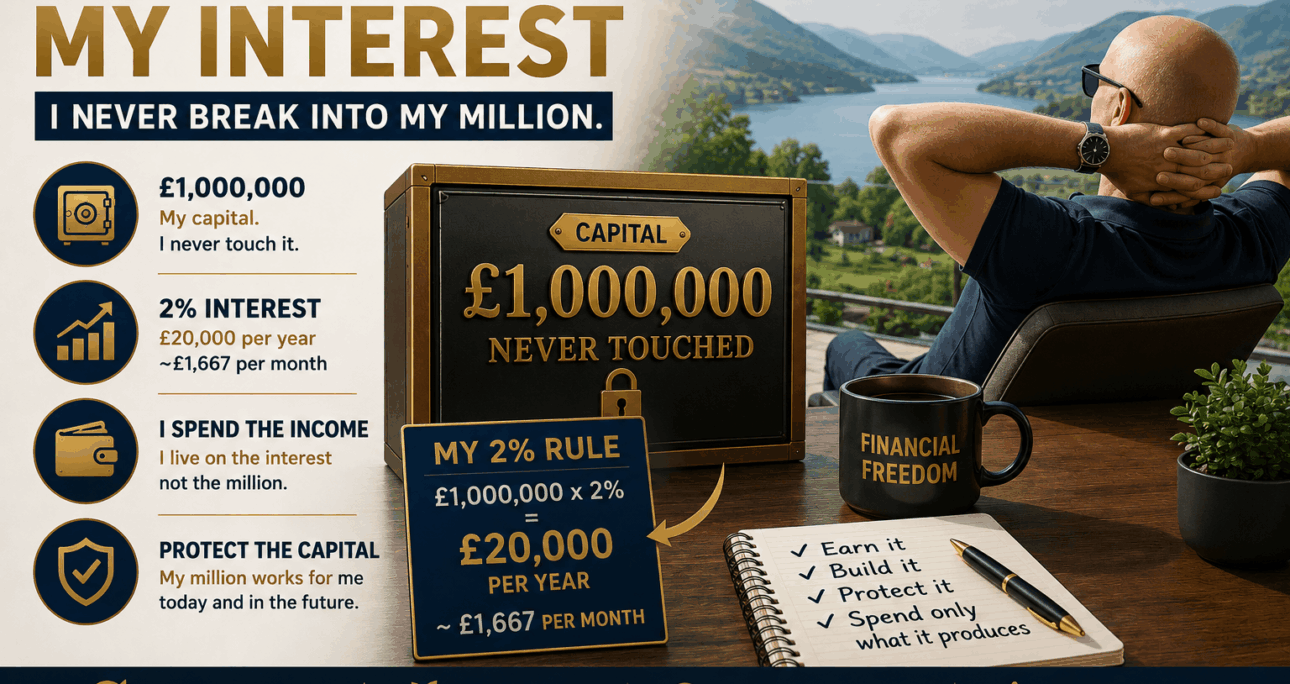
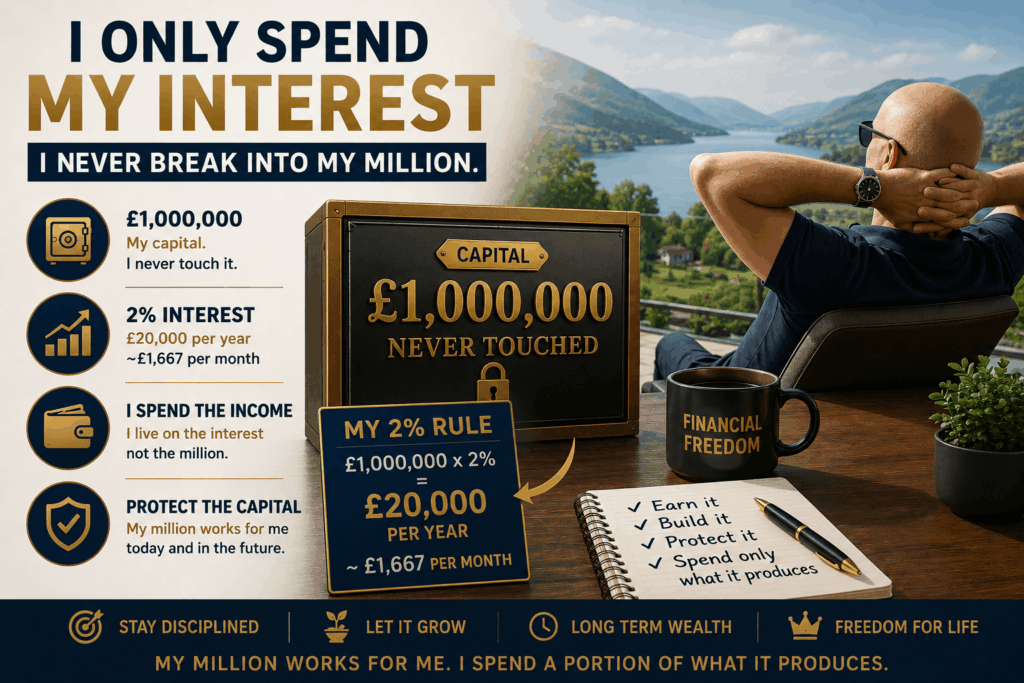
My financial goal is simple: build £1 million in capital and never break into it.
Instead of treating the million pounds as money to spend, I treat it as the engine that produces my spending money.
The 2% Rule
If £1 million produces an average income of 2% a year, that’s:
£1,000,000 × 2% = £20,000 per year
That’s roughly £1,667 per month before taking account of tax, fees, inflation and fluctuations in investment returns.
My principle would be straightforward: I can spend the income, but I don’t spend the million.
The £1 million remains invested.
The Million Is the Engine
Think of the capital like owning a machine that produces money.
If I start dismantling the machine to fund my lifestyle, eventually there won’t be much of a machine left. But if I protect the capital and live within the income it generates, the million can continue working for me.
That’s why reaching £1 million wouldn’t be an excuse for me to suddenly start spending extravagantly.
It would be about creating long-term financial independence.
Protect the Capital
My rule would be:
Earn it. Build it. Protect it. Spend only what it produces.
If the portfolio produces £20,000 at a 2% annual rate, that’s my spending allowance. I don’t start withdrawing another £50,000 because I fancy something expensive.
If I want a more expensive lifestyle, the answer isn’t necessarily to raid the million. The challenge is to increase my income or build more wealth.
What About Inflation?
There is an important complication: keeping the balance at exactly £1 million doesn’t necessarily preserve its real purchasing power.
Inflation means £1 million in 10 or 20 years may buy considerably less than £1 million buys today. Investment returns aren’t guaranteed either, and some years can produce losses rather than income.
So the bigger objective is not simply protecting the number £1,000,000. It’s building a diversified investment strategy capable of supporting withdrawals while protecting as much of the capital’s long-term purchasing power as possible.
Wealth Is About What You Keep
There’s a difference between having £1 million and spending £1 million.
I want to own the asset.
I want the asset producing income.
And I want to resist the temptation to destroy the source of that income for short-term spending.
My million isn’t my spending money.
My million works for me. I spend a portion of what it produces.